Halloween Skeleton Band Embroidery
A Playful, Punchy Design That Actually Stitches Well
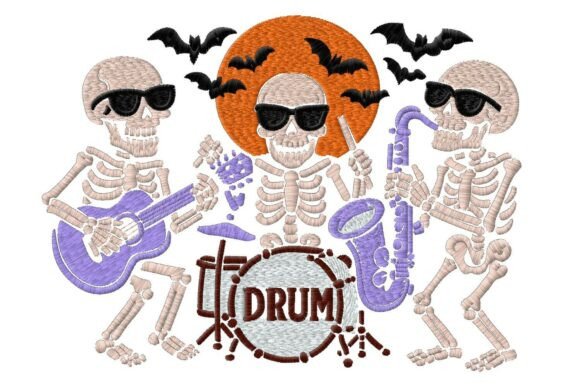
First impression? This isn’t just another spooky clipart knockoff. Halloween Skeleton Band Embroidery lands with a grin — energetic, musically irreverent, and visually cohesive. The composition centers on five distinct skeleton characters mid-jam session: one strumming a guitar (with visible frets and strings), another drumming, a third holding a tiny saxophone, and two dancing under a full orange moon. There’s rhythm in the layout — diagonal movement, layered silhouettes, and intentional negative space that keeps the design from feeling crowded. It reads instantly as “Halloween,” but also as “funny,” “musical,” and “handmade-friendly.” That balance is rare.
Where It Shines in Real Projects
I tested Halloween Skeleton Band Embroidery on a medium-weight cotton canvas tote bag for a local boutique’s seasonal launch — and it held up beautifully. The stitch density feels thoughtful: dense enough to read clearly at 4.5” wide, but not so heavy that it stiffens the fabric or overwhelms the structure. On a soft fleece-lined sweatshirt, the same design added personality without compromising drape. It works especially well as an embroidered patch — the clean outlines and moderate detail translate cleanly when heat-applied or sewn on. I also stitched it onto a linen tea towel for a small-batch holiday gift set; customers responded immediately to its charm and clarity, calling it “whimsical but not childish” and “perfect for adults who love Halloween but hate clichés.”
For Etsy sellers and craft fair vendors, this design bridges demographics: it appeals to Gen X music lovers, millennial parents looking for clever baby embroidery (think onesies or burp cloths — keep size scaled to 3”–3.5” for safety and clarity), and Gen Z shoppers wanting witty, shareable apparel. As a digital embroidery file, it’s versatile across product types — custom apparel, pillow covers, aprons for bakers or bartenders, even nursery decor (paired with neutral backgrounds and soft thread palettes). Its narrative strength — skeletons *playing music*, not just posing — gives it storytelling weight that boosts perceived value in handmade products.
Where to Proceed With Care
This isn’t a one-size-fits-all machine embroidery design. On stretchy knits like jersey t-shirts or baby bodysuits, stabilizer choice becomes critical. I recommend cutaway + tear-away combo for best definition on the guitar strings and drumstick details — otherwise, those fine satin stitch elements can blur. On dark fabrics, double-check thread contrast: the orange moon reads vividly on cream or light gray, but fades on charcoal unless you switch to neon orange or gold metallic thread (test first!).
Avoid using Halloween Skeleton Band Embroidery on curved surfaces like structured caps unless you’re confident in your cap frame setup — the horizontal band layout doesn’t wrap naturally, and distortion in the drum or guitar shape is noticeable. Also skip ultra-thin fabrics (like voile or lightweight rayon) without backing; the fill stitch areas around the moon and instrument bodies need support to prevent puckering. And while the design avoids micro-detailing (no tiny eyes or teeth), the smallest elements — like the saxophone keys or drumhead texture — do require a minimum 4” hoop and stable tension. Don’t force it into a 3” hoop unless you’re willing to simplify manually.
What It Adds — and What It Doesn’t Pretend To Be
This design elevates product perception. When stitched cleanly, it signals care, intention, and design literacy — not just “I ran a Halloween file through my machine.” Customers notice the spacing between figures, the consistent stitch direction in the moon’s glow, the way the guitar strap flows across the chest bone. That attention builds trust, especially for personalized gifts or boutique merchandise where buyers pay a premium for authenticity.
It doesn’t try to be minimalist, nor does it overcomplicate. There’s no excessive applique design layering, no fragile lace-like fills, no gradient color blends that demand specialty threads. It’s built for real-world embroidery machines and real-world timelines. That makes it ideal for small shop owners juggling multiple orders — you can run it consistently across batches without constant re-threading or digitizing tweaks.
Practical Designer Notes Before You Stitch
- Always test on scrap fabric first — especially if switching from cotton to fleece or denim.
- Review stitch density before finalizing: high-density areas (moon, drumhead) should sit flat without shadowing on lighter fabrics.
- Confirm hoop size: this design performs best in 5” x 7” or larger hoops. If your machine only supports 4” x 4”, check whether the vendor offers a simplified version.
- Inspect small details under magnification: are the guitar strings legible? Does the saxophone bell hold shape? Adjust tension or stabilizer if not.
- Test black-and-white mockups — many buyers preview digitally before purchasing. Does the design retain impact without color?
- Compare light vs. dark fabric backgrounds in your mockup software. Thread color choices change everything.
- Use proper stabilizer: medium-weight cutaway for stable fabrics; cutaway + tear-away hybrid for knits or towels.
- Verify licensing before selling finished items or reselling the digital embroidery file — commercial use rights vary by seller.
In short: Halloween Skeleton Band Embroidery is a smart, joyful, commercially viable embroidery file — not just seasonal filler. It rewards thoughtful execution and pays off in customer smiles, repeat orders, and that quiet satisfaction every designer feels when a digital embroidery file translates flawlessly into a tactile, beloved finished product.