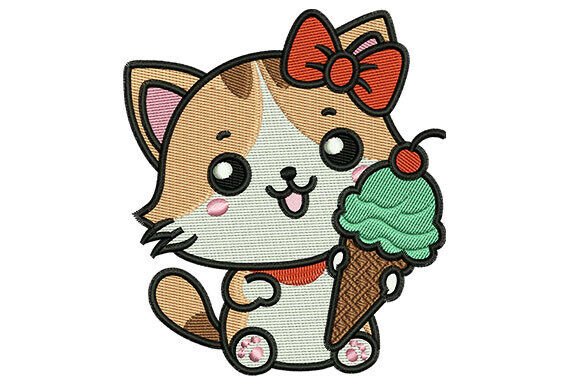
Ice Cream Kitten Embroidery Design
A Sweet Spot for Playful, Market-Ready Stitching
As a designer who’s stitched everything from boutique baby onesies to Etsy bestsellers, the Ice Cream Kitten Embroidery Design landed in my inbox on a humid Tuesday—right before I was prepping a batch of custom embroidered tote bags for a local kids’ summer camp. My first impression? It’s instantly disarming. Not cloying, not overly fussy—just a soft-eyed kitten cradling a waffle cone with gentle swirls and a single scoop that reads as joyful, not saccharine. That balance matters. In real-world use, it avoids looking like clip art or a dated cartoon—it breathes like something hand-drawn, then thoughtfully digitized.
Where It Shines (and Where It Asks for Care)
This design feels made for custom apparel and handmade product contexts where charm and clarity go hand-in-hand. I tested it on a lightweight cotton canvas tote—medium-density stabilizer, 40-weight poly thread—and the result held up beautifully: the satin stitch on the kitten’s ear had clean definition, the cone’s texture read clearly without overcrowding, and the overall shape sat comfortably within a 4x4 hoop. It’s ideal for sweatshirt embroidery where you want warmth without weight, or baby embroidery where softness and simplicity win.
But let’s be real: this isn’t a “set-and-forget” file. On stretchy fabric like jersey tees, the curved tail and narrow ice cream scoop require careful hooping and light tear-away stabilizer—otherwise, the fill stitch can pucker subtly near the cone’s base. And on dark fabric? The white or pale pink scoop can fade unless you add a subtle underlay or choose high-contrast thread colors. I ran a black-and-white mockup first—not just for client approval, but to check whether key details (like the kitten’s whiskers and the tiny scoop swirl) survived grayscale reduction. They did, but barely. So if you’re building printable mockups or digital embroidery file previews, test contrast early.
Real Project Pulse Check: A Nursery Pillow Cover
Last week, I used the Ice Cream Kitten Embroidery Design on a linen-cotton pillow cover for a newborn gift. The recipient loved it—but what mattered more was how it *behaved* during stitching. No thread breaks. No jump stitches hiding in the cone’s curve. The design avoided dense clusters that trap lint or resist washing. After two gentle machine cycles, the embroidery stayed crisp, with no fraying at the satin-stitched edges. That’s critical for baby embroidery or holiday embroidery meant to last beyond one season. It also translated well into a small shop product: the design felt cohesive with other nursery-themed assets—no jarring scale shifts or stylistic mismatches.
What This Design Says About Your Brand
When your customers see this on a personalized gift or boutique product, they don’t just see a cat and ice cream—they register intention. Thoughtfulness. A sense that you chose something with personality, not just pixels. That builds trust. For Etsy sellers and craft fair vendors, that quiet professionalism elevates perceived value—even on a $28 tea towel. It doesn’t scream “commercial embroidery,” but it wears that role well: clean, scalable, and emotionally resonant without leaning on trends that expire by August.
Smart Moves Before You Stitch
Before adding the Ice Cream Kitten Embroidery Design to your next project, do these five things:
- Test on scrap fabric—especially if using textured fabric like terry cloth or ribbed knit. The cone’s smooth curves can snag or distort on uneven surfaces.
- Review stitch density in your embroidery software. Some versions of this file run slightly heavier in the fill areas—adjust if needed for thin fabric or layered garments like reversible aprons.
- Confirm hoop size compatibility. While it fits neatly in standard 4x4 hoops, double-check your machine’s max dimensions—especially for caps or curved surfaces where even 1/8" overhang causes registration drift.
- Inspect small details closely: the tip of the cone, the kitten’s paw grip, the subtle shading in the scoop. If those vanish on your screen, they’ll vanish on fabric.
- Verify licensing before selling finished items or bundling the digital embroidery file. This is a commercial embroidery asset—but only if your license permits resale or derivative use.
Fabric & Fit Notes You’ll Actually Use
It works cleanly on cotton, linen, and medium-weight blends—but tread carefully on ultra-thin fabrics like voile or rayon challis. The satin stitch around the kitten’s face needs support, or it’ll sink and lose shape. For embroidered patches, consider adding a heat-seal backing after stitching—this design’s rounded silhouette holds up well when cut and fused. On caps? Possible, but only with a low-profile hoop and minimal fill. Skip it for dense applique design workflows unless you’re willing to simplify the cone detail manually.
And yes—it’s a Cats category file, but its strength lies in context, not taxonomy. It doesn’t shout “feline lover”—it whispers “summer joy,” “gentle play,” “handmade care.” That flexibility makes it valuable across categories: holiday embroidery (think Easter baskets or birthday party favors), personalized gifts (monogrammed + kitten = instant heirloom energy), and even kitchen-focused small shop products like oven mitts or dish towels where whimsy meets utility.
Final Thought: Design as Quiet Confidence
The Ice Cream Kitten Embroidery Design won’t revolutionize digitizing—but it delivers something rarer in the embroidery file market: reliability wrapped in charm. It’s the kind of machine embroidery design you recommend to a fellow Etsy seller not because it’s flashy, but because it ships well, photographs cleanly, and makes customers smile *before* they even hold the finished product. That’s the mark of thoughtful design work—and why, three projects in, it’s still in my active folder, not my archive.